
What happens at a private breast consultation in London?
A private breast consultation in London usually begins with a detailed discussion of symptoms, medical history, and any previous scans or treatment. A consultant breast surgeon then carries out an examination and, if needed, arranges imaging such as ultrasound or mammography, sometimes on the same day in a one-stop setting. The aim is to clarify what is going on, explain the next steps plainly, and make decisions based on the findings rather than guesswork.
Understanding the purpose of a private breast consultation
Many people book a private breast consultation because they have noticed a new symptom and want a clear assessment without delay. Others attend for a second opinion, follow-up after previous treatment, review of family history, or advice on surgery and reconstruction options.
Common reasons for attending include:
- a new lump, change in breast shape, skin change, or nipple discharge
- ongoing symptoms that need further assessment
- uncertainty after previous imaging or biopsy
- a wish to discuss surgical options in more detail
- a second opinion on diagnosis, treatment, or reconstruction planning
A private appointment is not a different type of medicine. It is another route into breast assessment and specialist review. In many cases, the same standards of imaging, pathology, and multidisciplinary team input apply across both private and NHS care, including links with settings such as The London Clinic or the Royal Free Hospital Breast Unit where relevant to a clinician’s wider practice.
What often feels different is the structure of the consultation. Consultant-led care usually means the discussion, examination, explanation, and planning are all driven by the consultant breast surgeon from the outset. That can be helpful for people who want time to go through symptoms carefully, understand the diagnostic pathway, or discuss more than one option.
A one-stop breast clinic can sit within this pathway when imaging is available on the day. That arrangement is best seen as a clinical tool to reduce uncertainty by coordinating assessment, rather than as a convenience feature. If a symptom needs examination, imaging, and possible biopsy planning, bringing those elements together can shorten the period of waiting between each stage.
What to expect during your appointment
Most private breast clinic appointments follow a clear sequence, although the exact order may vary according to symptoms and whether imaging has already been arranged.
- Arrival and registration Staff usually confirm your details, referral information, and any previous scans or reports. If you have attended because of a new symptom, the clinic may ask you to complete a short medical questionnaire before the consultation begins.
- Discussion with the consultant The consultant breast surgeon will ask about the symptom itself, when it started, whether it has changed, and whether there are any related issues such as pain, skin changes, nipple discharge, or swelling. Your wider medical history matters too, including previous breast surgery, hormone treatment, medication, and relevant family history.
- Breast examination An examination is usually carried out in a private room with dignity maintained throughout. You may be asked to undress from the waist up and wear a gown. The surgeon generally examines both breasts and the lymph node areas under the arms and around the collarbone, because comparison often matters.
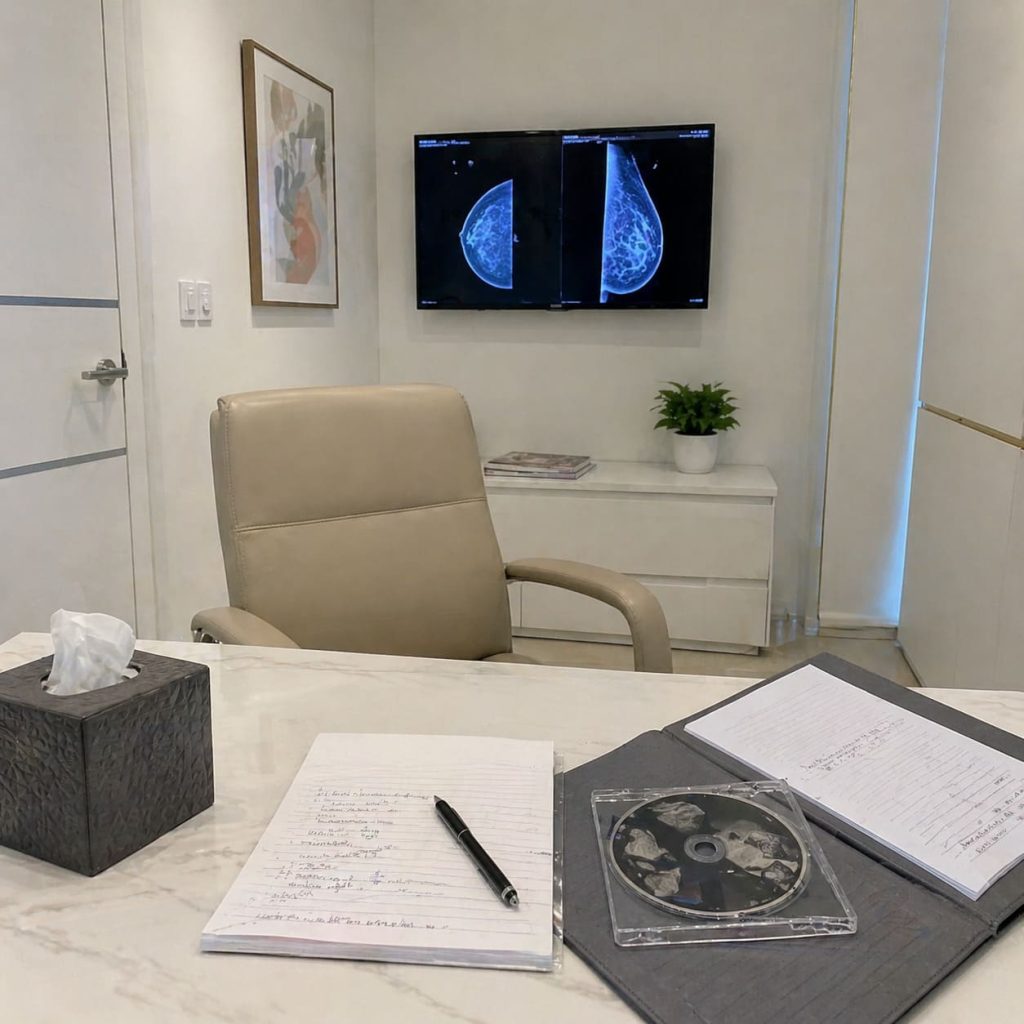
- Imaging if required If the findings need further assessment, the next step may be an ultrasound, a mammogram, or both. In a one-stop setting, imaging may happen during the same visit, often with a radiologist involved in the assessment.
- Discussion of findings and next steps Once the clinical picture is clearer, the consultant explains what has been found, what remains uncertain, and whether any further test is needed. You should have time to ask questions before leaving.
No two appointments are exactly the same. A younger patient with a simple cyst, for example, may need ultrasound alone, whereas someone with a more complex history may need additional imaging, biopsy planning, or later review through the MDT.

Expert advice on breast cancer treatment, cosmetic breast surgery, and reconstruction options in London.
Book a ConsultationKey tests and assessments you may encounter
Breast assessment often involves imaging, and each test answers a slightly different question. The choice depends on your age, symptoms, examination findings, and any previous breast surgery.
Mammogram
A mammogram is an X-ray of the breast. It is often used to look for changes that cannot be felt easily, including calcifications or areas of distortion. The breast is compressed briefly during the scan, which some people find uncomfortable, although the pressure only lasts a short time.
Ultrasound
Ultrasound uses sound waves rather than X-rays. It is particularly useful for assessing a lump, distinguishing a fluid-filled cyst from a solid area, and examining the underarm if needed. During the scan, gel is applied to the skin and a handheld probe is moved over the area.
MRI
MRI is not routine for every breast clinic appointment. It may be recommended if the picture remains unclear after mammogram and ultrasound, if breast tissue is dense, or if surgery planning needs more detail. Some patients also encounter MRI in higher-risk assessment or reconstruction planning.
Core biopsy
If imaging shows an area that needs tissue sampling, a core biopsy may be advised. After local anaesthetic is given, a needle removes small samples of tissue for examination in the pathology lab. This is done to identify what the tissue is, not because cancer is assumed.
Results are not always immediate. Imaging may be discussed on the day, but biopsy findings need laboratory analysis, which takes longer because the tissue has to be processed and reported carefully.
Some readers also come across terms such as wire-free localisation or fluorescence-guided surgery when reading about breast treatment. Those are not standard consultation tests. They are techniques that may be relevant later if surgery is needed, particularly when a small area seen on imaging must be located accurately in theatre.
Bring copies of any previous imaging or relevant medical records to your consultation to ensure your doctor has the complete picture.

How to prepare for your consultation
A little preparation can make the appointment smoother and help you use the time well.
Bring whatever is already available, including your appointment letter, referral details, previous imaging reports, pathology results if you have them, a list of current medication, and any relevant family history information. If you have had mammograms, ultrasound scans, or surgery elsewhere, copies of reports are often useful.
Wear clothes that are easy to change out of, since you may need an examination or breast imaging. Avoid applying talc, powder, or deodorant immediately before a mammogram if the clinic has advised against it.
It can also help to note down a short symptom timeline. Include when you first noticed the problem, whether it changes with your cycle, and whether anything has made it better or worse. A brief written note is often more useful than trying to remember details under pressure in the room.
If you know you are likely to forget your questions, write them down in advance. Sensible topics include what the likely causes are, whether imaging is needed, what a biopsy would involve, and when results are expected.
Emotional preparation matters as well. Many people arrive worried that every symptom must mean something serious, but breast clinics assess benign and malignant conditions. Going in with the aim of getting a clear explanation, rather than demanding certainty before any tests are done, usually leads to a steadier consultation.
Prepare a short written timeline of your symptoms and key questions to help focus the discussion and get the answers you need.

What happens after the consultation
The next step depends on what was found during the appointment. Some patients leave with reassurance and no further action beyond routine awareness or follow-up. Others need imaging, biopsy, review of results, or referral into treatment planning.
If you have imaging on the day, the consultant may be able to explain the findings before you leave. Where a biopsy has been taken, results usually come later once the pathology lab has completed its analysis. That follow-up may take place in clinic, by agreed communication, or during a planned review discussion.
Cases that involve cancer or a more complex diagnosis are often considered through the MDT. That means radiology, pathology, surgery, and oncology findings are reviewed together so that treatment planning is based on the full picture. In private practice, that collaborative approach still matters because no single test gives every answer.
Sometimes the outcome is a recommendation for surgery, and sometimes it is further imaging or interval review. In other situations, the advice may be to do nothing active at all because the finding is benign and stable. At D B Ghosh Breast Surgeon Specialist in Cancer and Cosmetic Surgery Harley Street London, this stage of care is generally framed around explanation and decision-making rather than rushing into treatment.
A second opinion may also remain appropriate after the consultation, particularly if there are several reasonable options or if previous surgery makes planning more complex. A well-run appointment should clarify the choices, the trade-offs, and the likely sequence of care, even when one result is still pending.

Common misconceptions and questions to ask
Private breast consultations are sometimes misunderstood. One common myth is that every appointment leads straight to treatment. In practice, many visits end with reassurance, monitoring, or clarification of a benign issue.
Another misunderstanding is that all tests can be completed and reported immediately. Imaging may be available on the day, but pathology needs time. A biopsy result is not delayed because something is wrong. It is delayed because tissue analysis must be done properly.
Some people also assume that private and NHS care operate in separate clinical universes. The route into care may differ, yet the principles of safe breast assessment, imaging review, pathology reporting, and MDT discussion remain the same.
Questions can make the discussion more useful, particularly if you want to understand why a recommendation is being made. One well-focused list is usually enough:
- What do you think this symptom is most likely to be?
- Do I need imaging, and which type would be most useful?
- If you are recommending a biopsy, what are you trying to clarify?
- When and how will results be explained?
- If treatment is needed, what options are reasonable in my case?
- Would any decision benefit from MDT review, genetics input, or a further opinion?
- If nothing urgent is found, what changes should prompt me to come back sooner?
A breast care nurse may also be involved at points in the pathway, particularly if a diagnosis becomes more complex or treatment is being planned. That support can be helpful for practical questions that often arise after the consultation has ended.
Expert breast surgery advice from a leading London consultant with over 30 years of experience.
Book ConsultationLooking beyond the appointment: what informed patients gain
A private breast consultation is best understood as one step in a process of clarification. For some people, that process is short and reassuring. For others, it opens a sequence of scans, pathology results, MDT discussion, and treatment planning.
Good preparation does not remove uncertainty, but it does make uncertainty easier to handle. Knowing what the appointment is for, what tests may follow, and how decisions are usually made can turn a difficult day into a more manageable one.
Clear information supports better choices, especially where there is more than one reasonable option. That may apply to biopsy decisions, timing of surgery, breast-conserving treatment, mastectomy, reconstruction, or the value of a second opinion.
The most useful mindset is often a practical one. Go to the consultation ready to explain what has changed, ready to listen to what the findings do and do not show, and ready to take the next step based on evidence rather than fear.