
What should a breast surgeon explain before you agree to surgery?
A breast surgeon should explain your diagnosis in plain English, why surgery is being considered, what the operation is intended to achieve, what alternatives may exist, and what risks, limits, and recovery should look like in broad terms. You should also understand how decisions are being made, whether your case has been reviewed with radiology, pathology, oncology, or an MDT, and what questions remain unanswered before consent is given.

Understanding your diagnosis and why surgery is being considered
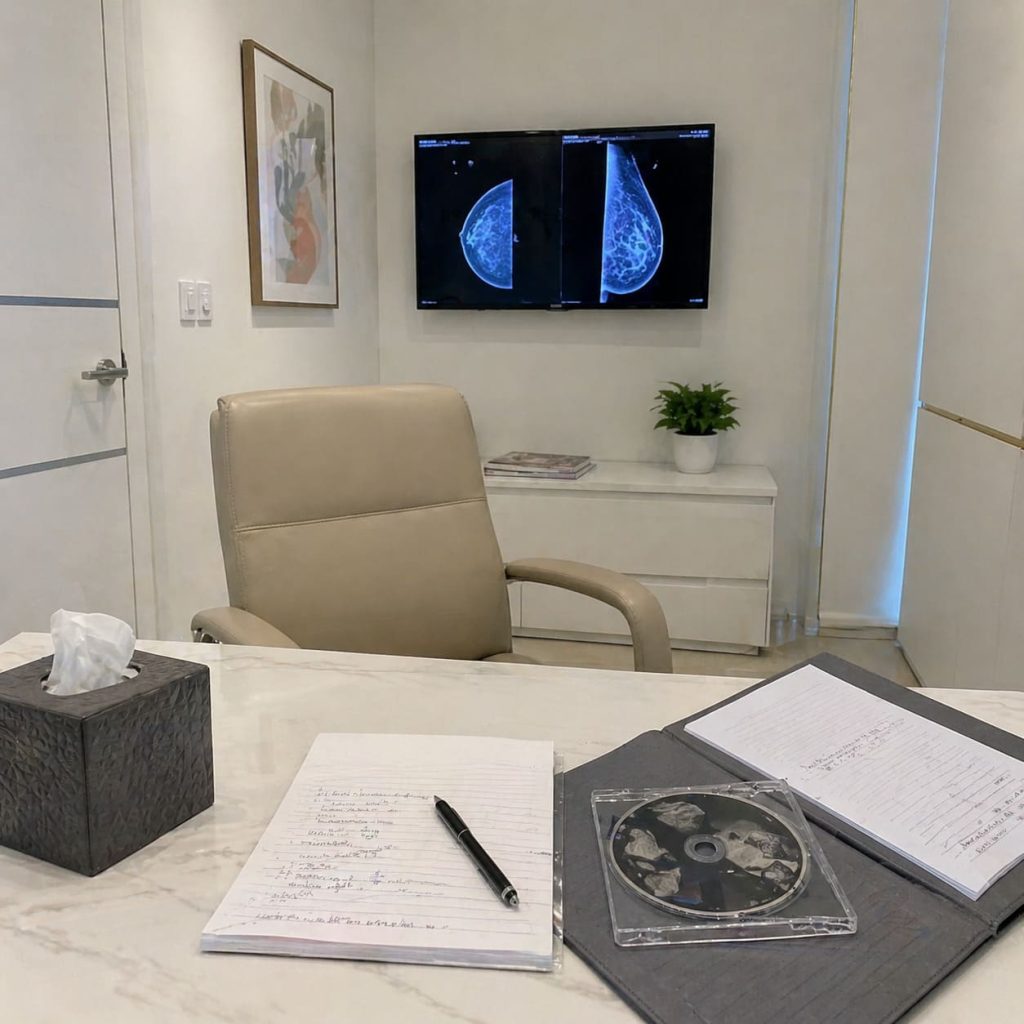
Before any discussion about an operation, the diagnosis itself needs to be clear. A consultation should cover what has been seen on breast imaging, what a biopsy has shown if one has been done, and how those findings fit with the examination.
Some breast conditions are benign, which means they are non-cancerous and may need monitoring, reassurance, or a smaller procedure. Others are malignant, which means cancer is present and treatment needs to focus on safe removal, staging, and the wider treatment pathway. In some situations, surgery is advised because a diagnosis is already confirmed. In others, surgery is discussed because the result is uncertain, symptoms are troublesome, or a lesion needs to be removed to settle the diagnosis properly.
A clear explanation often includes these points:
- What the imaging showed, including whether the concern was seen on mammogram, ultrasound, or MRI
- What the pathology report found, including whether cells were benign, abnormal, or cancerous
- Why surgery is being recommended now, and whether any non-surgical option is reasonable
NHS practice and NICE guidance support treatment planning based on evidence from imaging, pathology, and specialist review, rather than on a single test in isolation. If details seem blurred together in clinic, it is reasonable to ask which part of the decision comes from the scan, which part comes from the biopsy, and which part comes from the wider clinical picture.
Misunderstandings often begin when surgery is discussed before the diagnosis feels settled in the patient’s mind. A lump does not automatically mean cancer, and a cancer diagnosis does not always mean the same type of surgery for every person. Margin requirements, tumour size, breast size, location within the breast, and previous treatment can all alter the plan.
Expert advice on breast cancer treatment, cosmetic breast surgery, and reconstruction options in London.
Book a ConsultationWhat your surgeon should explain: the procedure, options, and trade-offs
Once the diagnosis and surgical indication are clear, the next step is the operation itself. A good consultation should make it plain what is being proposed, what the realistic alternatives are, and what trade-offs come with each option.
Breast-conserving surgery and mastectomy
Breast-conserving surgery, often called a lumpectomy or wide local excision, removes the area of concern with a rim of normal tissue around it. A mastectomy removes more breast tissue and may be advised when the cancer is large relative to breast size, spread through more than one area, or unlikely to be removed acceptably with conservation.
Neither operation is simply the “bigger” or “better” choice. The safer option depends on the disease pattern, the breast itself, and whether clear surgical margins are likely. In many cases, the real comparison is between preserving more breast shape now and reducing the chance of needing further surgery later.
Oncoplastic surgery and shape
Oncoplastic surgery combines cancer surgery with reshaping techniques where appropriate. That may mean moving breast tissue after a cancer is removed, reducing one or both breasts, or planning later symmetry procedures. The purpose is not cosmetic in the ordinary sense. The aim is to remove disease safely and then consider shape, balance, and long-term contour where that can be done sensibly.
An experienced surgeon should explain where oncological safety comes first and where there is room for flexibility. A cancer close to the skin, nipple, or chest wall may limit certain reshaping plans, whereas a smaller tumour in a larger breast may allow broader options.
Lymph node surgery
If there is concern about spread to the lymph nodes, your consultation should cover whether a sentinel node biopsy or axillary surgery is being considered. A sentinel node biopsy samples the first draining nodes and is often less extensive than a full clearance. The reason for doing it, and the possible implications of the result, should be spelled out before the day of surgery.
Reconstruction timing and type
If mastectomy is part of the discussion, reconstruction should be explained in an even-handed way. Some patients may be suitable for immediate reconstruction during the same operation. Others may be advised to delay reconstruction because of likely radiotherapy, smoking risk, healing concerns, medical history, or personal preference.
Broadly, reconstruction options may include:
- Implant-based reconstruction
- Autologous reconstruction using your own tissue
- Delayed reconstruction after cancer treatment
- No reconstruction, with or without an external prosthesis
Each route carries practical consequences. Implant-based reconstruction may involve a shorter initial operation but can raise later questions about implant position, capsular tightening, or future revision. Autologous reconstruction uses your own tissue and may give a more natural feel, though the surgery is usually longer and recovery can be greater because another part of the body is involved.
A surgeon should also say plainly when an option is technically possible but not necessarily the best fit. That distinction matters. Choice is real, but it is not infinite, and anatomy often sets the boundaries.
Bring notes or a trusted companion to your appointment to help remember key discussion points and explanations.

Risks, benefits, and what recovery really involves
Every operation has intended benefits, known risks, and a period of recovery that rarely follows a perfect script. Consent is stronger when all three are discussed together.
Potential benefits may include removing a cancer, obtaining a firmer diagnosis, reducing symptoms, lowering future risk in selected high-risk cases, or making later treatments possible. Limits also need to be stated. Surgery cannot guarantee that no further treatment will be needed, and reconstruction does not restore the breast exactly as it was before.
Common risks vary by procedure, though they often include:
- Bleeding
- Infection
- Fluid collection
- Delayed wound healing
- Changes in breast shape or sensation
- Scarring
- Need for further surgery if margins are not clear
- Arm stiffness or swelling after lymph node surgery
Lymphoedema deserves a separate mention because patients often hear the term without much explanation. It refers to swelling, usually of the arm, linked to disruption of lymphatic drainage after axillary surgery or radiotherapy. Risk depends on the type of treatment received. In selected cases, approaches such as LYMPHA may be discussed as part of lymphoedema prevention, but it does not apply to everyone.
Recovery also needs to be described in practical language. Pain is usually manageable, though discomfort, tightness, numbness, and fatigue are common early on. Drains may be used after some procedures. Driving, exercise, lifting, work, and sleep positions may all be affected for a period, and physiotherapy advice is often important after surgery involving the breast, chest, or axilla.
Royal College of Surgeons guidance and standard post-operative care pathways support clear advice on wound care, mobility, and warning signs. A useful consultation should cover what normal healing looks like, which symptoms need review, and whether pathology results after surgery could alter the next stage of treatment. A person returning to desk work after a small excision may recover very differently from someone having mastectomy with reconstruction and node surgery.

The role of the multidisciplinary team and consultant-led care
Breast surgery planning rarely happens in isolation. Radiology, pathology, oncology, and surgical input are commonly brought together through an MDT so that scan findings, biopsy results, and treatment options can be reviewed in context.
That does not mean care becomes impersonal or fragmented. Consultant-led care means one clinician remains responsible for explaining the plan, interpreting the team discussion, and helping the patient make sense of what comes next. Team input supports the decision. It should not replace ownership of the consultation.
At a practical level, MDT involvement may shape care in several ways. Imaging may be reviewed again if the lesion is hard to define. Pathology may clarify whether more tissue is needed. Oncology input may affect timing, particularly if chemotherapy or radiotherapy could influence surgical planning.
In a one-stop assessment setting, the value is coordination rather than speed for its own sake. Examination, imaging, and biopsy planning can be aligned so that uncertainty is reduced early. In London-based consultant breast and oncoplastic care, including D B Ghosh Breast Surgeon Specialist in Cancer and Cosmetic Surgery Harley Street London, the point of that structure is to support sound decisions when details are still unfolding.
A patient may hear several specialists mentioned and worry that nobody is seeing the whole picture. In reality, the opposite is usually intended. The useful test is simple: after all the specialist input, can your consultant explain the plan clearly, in one coherent account, using your scans and biopsy findings rather than generalities?
Ask your consultant to clarify how your imaging and biopsy findings fit together before making any decisions.

Questions to ask if your surgeon hasn’t covered key points
A consultation does not need to feel adversarial for it to be thorough. If important details have not been covered, direct questions can bring the discussion back to what matters.
- What exactly is my diagnosis, and which part comes from the scan, the biopsy, and the examination?
- Why is surgery being advised in my case, and are there any reasonable alternatives?
- What operation are you recommending, and what is the main aim of it?
- If I have a choice, what are the practical trade-offs between those options?
- What are the chances that I might need more surgery after this procedure?
- Will lymph node surgery be part of the operation, and why?
- Am I suitable for immediate reconstruction, delayed reconstruction, or neither at present?
- What should I expect in the first few days and weeks after surgery?
- Which risks matter most for this specific operation?
- Has my case been discussed in an MDT, or is that planned?
- Do I need to make this decision now, or do I have time to reflect?
- Would a second opinion be reasonable if I remain unsure?
Questions about consent are equally valid. GMC guidance and NHS informed consent standards support a discussion that gives patients time, clarity, and a real chance to weigh alternatives. If explanations remain vague, asking for the plan to be restated in plain language is sensible, not difficult.
Second opinions also have a legitimate place, especially where anatomy is complex, reconstruction options differ, or recommendations seem finely balanced. Some patients seek them through an NHS pathway. Others may use a specialist service such as the Rapid Diagnostic Centre, 146 Harley St, London W1G 7LD, when they want another consultant review of imaging, pathology, and operative planning.

Expert breast surgery advice from a leading London consultant with over 30 years of experience.
Book ConsultationBeyond the consultation: common misconceptions and what informed consent really means
Many people leave clinic thinking consent is mainly a form to sign. In practice, informed consent is a process of explanation and decision-making, with the form acting as a record of that conversation.
One common misconception is that being told the name of an operation is enough. Genuine understanding also includes why that procedure is proposed, what the alternatives are, and what uncertainties remain. Another is that agreeing to surgery means every detail is fixed. Post-operative pathology may still affect margins, further treatment, or later reconstructive decisions.
Some patients worry that asking repeated questions signals distrust. In fact, careful questions usually show engagement. Breast surgery decisions often involve anatomy, pathology, timing, body image, future treatment, and personal priorities all at once. Taking time to think is part of good decision-making, not a delay for its own sake.
A pause can be appropriate if the diagnosis is clear but the surgical route is finely balanced. By contrast, there are situations where timing matters more and the surgeon should explain why. What matters most is that the reason for urgency, or lack of it, is made explicit rather than assumed.
Patient advocacy groups often encourage people to bring notes, ask for unfamiliar terms to be explained, and review information after the appointment. That approach fits well with GMC guidance. Being informed means having enough clear, relevant information to make a decision you understand, even if the choice itself is difficult.
The best consultation does not leave you with every fear removed. It leaves you with a clear diagnosis, a defined plan, and a sound grasp of what is known, what is uncertain, and what matters most before you say yes to surgery.