
What causes breast pain in women?
Breast pain is treated as a symptom rather than a diagnosis, and understanding the causes of breast pain depends on placing that symptom into proper clinical context. In clinical practice, it is approached as information that needs context rather than a conclusion that stands on its own. The cause may relate to breast tissue itself, to hormonal influence, or to structures around the breast that share nerve pathways. Understanding why breast pain occurs starts with understanding how clinicians interpret symptoms, patterns, and contributing factors together.
Pro Tip: Pain that changes in location or character often reflects shifting influences rather than a new underlying problem.

Understanding breast pain as a symptom, not a diagnosis
When a woman describes breast pain, the starting point is careful listening rather than labelling. Pain is a signal that reflects sensitivity or change, and in the breast it can arise for many different reasons. The same sensation can carry different meanings from one person to another.
In clinical discussions, pain, tenderness, and discomfort are considered separately because each describes a slightly different sensory experience. These differences are shaped by breast tissue composition, nervous system sensitivity, and hormonal regulation. Pain perception is personal, which explains why similar physical changes can feel very different between women.
For this reason, breast pain is never interpreted on its own. During clinical assessment, the symptom is placed into context using timing, location, and pattern. Seen this way, breast discomfort becomes information that guides understanding rather than something that prompts immediate conclusions.
Consultant Breast Assessment
How breast tissue responds to hormonal change
Breast tissue responds to hormones because of its biological role and structure. Oestrogen and progesterone influence the fibroglandular tissue within the breast, affecting fluid balance, tissue tension, and sensitivity.
These hormonal effects are part of normal endocrine activity, shaping breast tissue sensitivity rather than indicating abnormality. They do not imply fault or dysfunction. Some women notice breast pain or tenderness with relatively small hormonal shifts, while others notice very little. Breast density and tissue sensitivity help explain this variation.
Hormonal influence extends beyond the menstrual cycle. Pregnancy, breastfeeding, hormonal contraception, and the years around menopause all create hormonal environments that can alter how breast tissue feels. When clinicians refer to hormone related breast pain, they are describing an interaction between circulating hormones and tissue responsiveness rather than identifying a single named condition.
Pro Tip: Breast pain is most meaningful when patterns are considered over time rather than judged from a single moment.
Structural and tissue related causes within the breast
Some breast pain arises from the structure of the breast itself. The breast contains glandular tissue, connective tissue, and ductal structures, all of which can be sensitive to mechanical strain or subtle changes in elasticity.
Pain may be localised to a particular area or felt more diffusely, reflecting pain in breast tissue rather than a single focal change. Importantly, pain can occur even when there is no lump or visible abnormality. Tissue sensitivity does not always produce something that can be seen on imaging or felt on examination.
Using spatial language often helps clarify this for patients. Pain may feel close to the surface or deeper within the breast. It may be influenced by movement or pressure. These patterns help clinicians understand whether discomfort is related to tissue mechanics rather than to a discrete lesion.
Second Opinion on Breast Symptoms
Pain that feels like it is in the breast but is not
A common source of confusion is pain that feels as though it is coming from the breast, but actually originates elsewhere. This is known as extramammary pain.
The chest wall, including the intercostal muscles and rib cartilage, lies directly beneath the breast. Strain, inflammation, or irritation in these structures can be perceived as breast pain because they share sensory nerve pathways with the breast. The nervous system does not always distinguish the precise origin of discomfort.
This explains why breast imaging can appear normal while pain continues. The sensation is genuine, but its source lies outside breast tissue. Understanding this mechanism often brings clarity because it accounts for symptoms that might otherwise feel unexplained.
How life stages can influence breast pain
Breast pain does not occur in a static biological environment. Across different life stages, breast tissue adapts to changing hormonal and physiological conditions.
During puberty, breast development involves tissue growth and heightened sensitivity. Pregnancy introduces changes in breast structure, blood flow, and hormonal exposure. Breastfeeding can increase sensitivity through milk production and ductal activity.
Later, perimenopause and menopause involve gradual shifts in reproductive hormones that alter tissue responsiveness. These phases are best understood as transitions rather than discrete problems.
New sensations that arise during life stage changes do not automatically signal pathology. Clinically, the focus remains on how the pain fits into the broader picture of physiological adaptation.
Why breast pain often has more than one cause
In clinical practice, breast pain rarely has a single explanation. More often, it reflects overlapping contributors. Hormonal tissue sensitivity may coexist with chest wall strain, or structural breast sensitivity may be amplified by changes elsewhere in the body.
Breast pain patterns can change over time without indicating progression or deterioration. As one contributing factor settles and another becomes more prominent, the character or location of pain may shift. Clinically, this is understood as a change in balance between influences rather than the emergence of a new problem.
This layered causation is central to clinical reasoning and helps explain complex breast pain driven by overlapping breast pain causes. Simplifying pain to one cause can be misleading. Instead, clinicians look for patterns and correlations that help prioritise which factors matter most in a given situation.
How specialists make sense of breast pain
Specialist assessment of breast pain follows a structured clinical process rather than assumption. It begins with a detailed clinical history, focusing on the pattern of symptoms, how the pain feels, when it occurs, and whether anything appears to influence it. This information helps clinicians distinguish breast pain symptoms arising from breast tissue from pain felt in the breast due to nearby structures.
Physical examination adds another layer of understanding. Examination of the breast tissue, surrounding chest wall, and musculoskeletal structures allows clinicians to assess tissue sensitivity, localised tenderness, and signs of chest wall breast pain. These findings are interpreted together rather than in isolation.
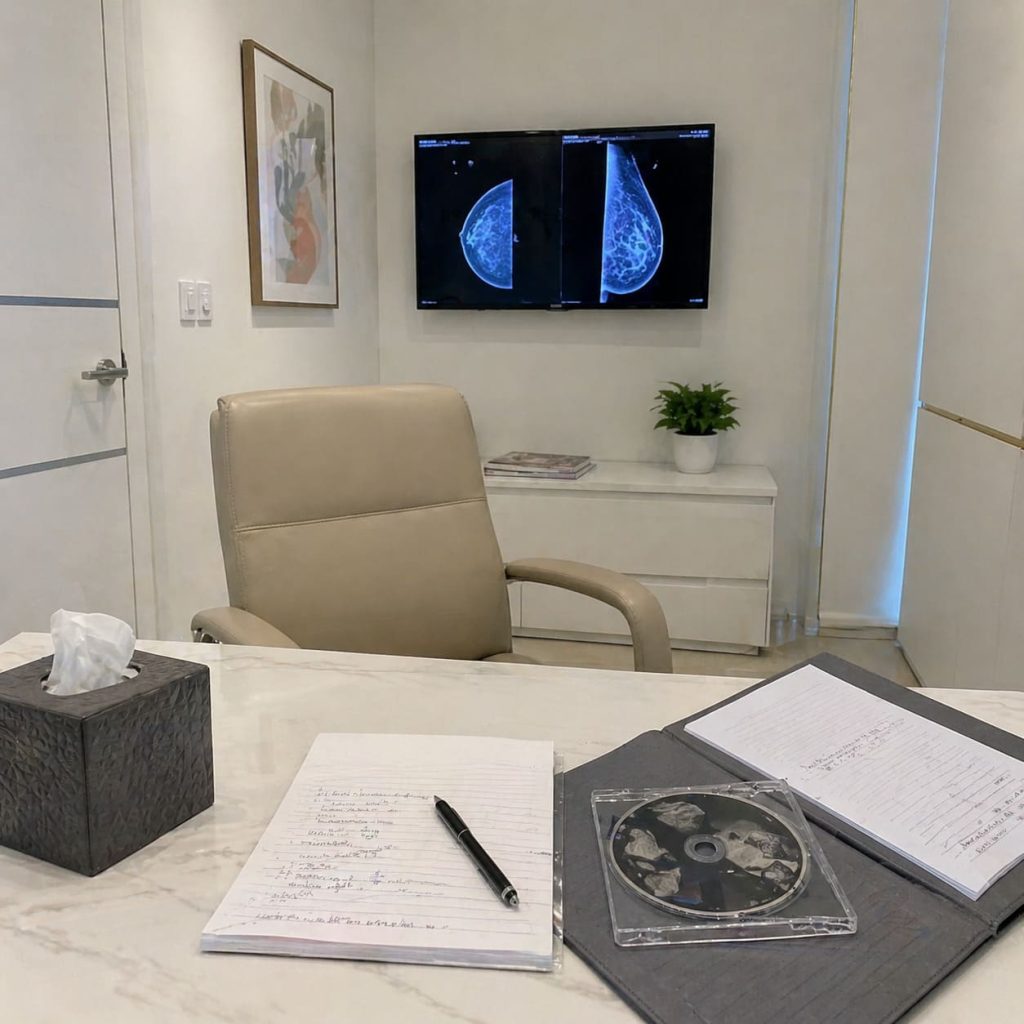
Imaging is introduced when it contributes meaningful clarity. Ultrasound or mammography may be used to correlate symptoms with structural findings, but normal imaging does not invalidate ongoing pain. Instead, it helps narrow the diagnostic context through exclusion based reasoning and pattern evaluation.
Continuity over time is an important part of specialist assessment. Stability or gradual change in symptoms across follow-up can be clinically meaningful, helping to confirm patterns and rule out evolving concerns. This longitudinal view often provides reassurance grounded in observation rather than assumption.
In specialist practice, including the approach taken by Dr D B Ghosh, breast pain evaluation is guided by experience across a wide range of benign and malignant breast conditions. The emphasis is on understanding overlapping contributors, correlating findings, and maintaining continuity of care. As Dr D B Ghosh often explains in consultation, clarity comes from methodical assessment and thoughtful interpretation rather than from rushing to conclusions.